How to Accept an AI Agent's Work: A 5-Minute Review Checklist
"I won't understand what it wrote" is the top fear with agents. What to check in the diff, tests and preview to accept the work in 5 minutes without reading every line.
Operon Editorial, Team ·
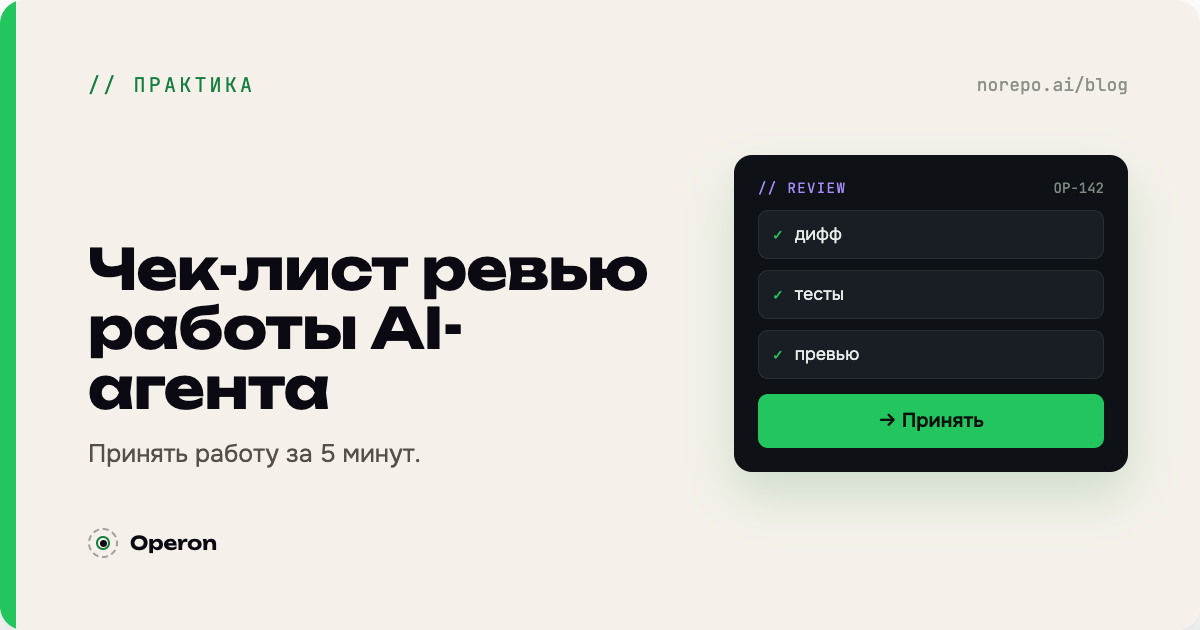
The top fear when working with AI agents sounds like this: "I'm not technical, I won't understand what it wrote." The good news — you can accept an agent's work in five minutes, without reading the code line by line. It's enough to check four things: match to the criteria, the diff, the tests and the preview. Let's walk through a practical acceptance checklist and the moment when you should still call a developer.
Why you don't need to read every line
Reviewing an agent's work isn't rewriting after it — it's checking the result against what you ordered. If the task was set with acceptance criteria (and a good task is exactly that — see how to brief an AI agent), then acceptance boils down to "matches / doesn't match." Line-by-line reading is needed selectively — on sensitive spots, not across the whole diff.
The 5-minute acceptance checklist
Run through the points — this is enough for most tasks:
- Acceptance criteria. Open the task and compare: is exactly what you asked for done? Nothing missing, nothing extra.
- Diff size and clarity. Are the changes proportional to the task? A small, tidy diff is good. A huge one scattered across the whole project is a reason to pause.
- Tests. Did the automated checks pass? If the agent added tests for the new logic — excellent.
- Preview. Open the preview build or run it locally: does the feature work as expected on a live screen?
- Boundaries. Did the agent stay out of where it wasn't asked (payments, auth, other modules)?
If all five match, the work can be accepted. Doubt any one of them — don't merge.
When to call a developer
Five minutes isn't always enough. Show the changes to a human if:
- the diff is large and unclear, and you couldn't split the task;
- tests don't pass, or there are none where the logic is non-trivial;
- sensitive areas are touched: payments, authorization, personal data;
- the agent went beyond the task's boundaries.
This isn't the agent failing — it's normal insurance. More on the classes of risk in security when agents write your code.
What shouldn't happen
A couple of red flags of process, not code. The agent shouldn't merge on its own — only open a pull request for review. And acceptance shouldn't turn into reading everything: if every time you have to comb through hundreds of lines, the tasks are being set too large — break them up, and review goes back to five minutes.
Bottom line
- You can accept an agent's work in 5 minutes: criteria, diff, tests, preview, boundaries.
- Line-by-line reading is needed selectively, not across the whole diff.
- Call a developer for large unclear diffs and sensitive areas.
- The review gate is your insurance: if in doubt, don't accept — return the task.
Start free: 2 tasks a week, no card — norepo.ai. See how acceptance works on the board on the product page.