How to Replace Jira in 2026: Alternatives for AI-Agent Teams
Jira is expensive and heavy for small teams. We compare the 2026 alternatives and the approach where tasks aren't just stored — they get done.
Operon Editorial, Team ·
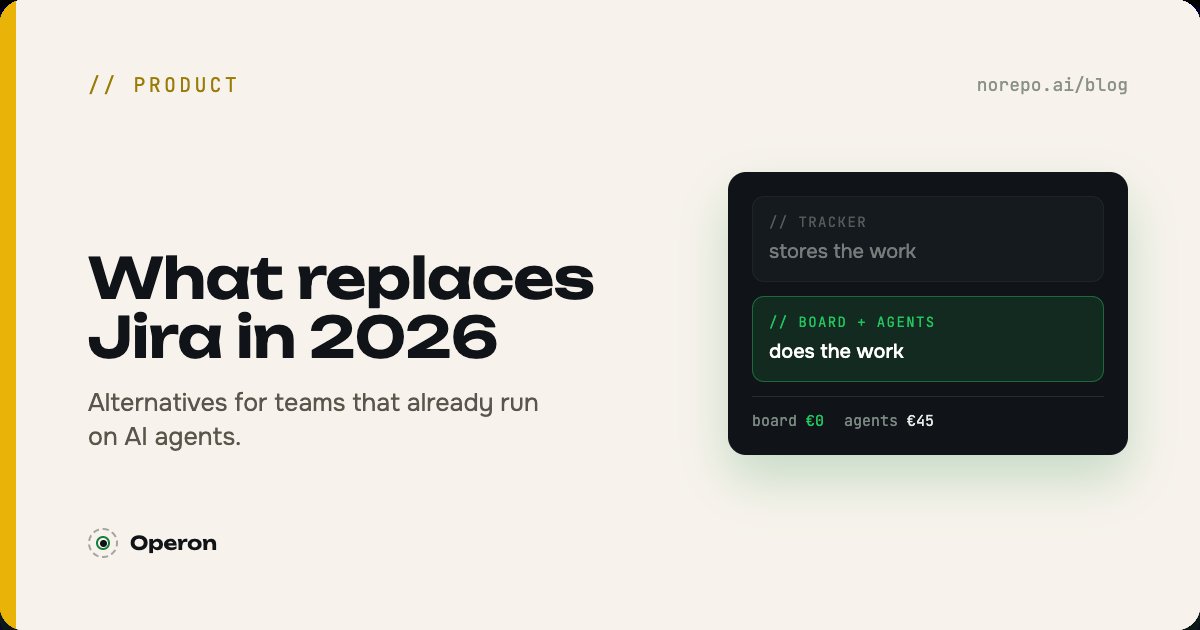
Jira stores tasks well, but for a team of 1–15 it's expensive and heavy: you pay per seat, configure it for months, and the work still gets done by people you hire. In 2026 there are plenty of alternatives — from lightweight trackers to boards where tasks don't just sit, they get executed by AI agents. Let's compare honestly: pricing, who each fits, and when Jira is still worth keeping.
When Jira becomes a burden
Jira was built for large teams and complex processes. If you're five to fifteen people shipping fast and building with Claude Code or Cursor, you pay for what you don't use: heavy workflows, roles, fields and Marketplace add-ons. And you pay twice — for licenses and for the people doing the work. Meanwhile the bottleneck moved long ago from "writing code" to "specifying and assigning the task" — and a tracker doesn't solve that part.
The alternatives
Short and honest, no fluff.
- Linear — a fast, polished tracker beloved by product teams. You still type and do the work by hand, but the UI beats Jira.
- Notion — a wiki with board elements. Great for docs and light process, weaker as a strict tracker.
- Trello — simple kanban with no brains: fine for small tasks, hard to scale process.
- ClickUp — many features in one, at the cost of complexity; risk of a "second Jira".
- Operon — a board where AI agents do the work: a task goes to an agent, it writes the code and submits for review. The board is free; you pay for the AI team.
How "board + agents" is different
Every tracker above shares one thing: it shows the work but doesn't do it. That's why we build Operon differently — as an interface between people and agents. You state a task in chat in plain words, the AI sharpens the wording and acceptance criteria, the card moves onto the kanban, and the executor becomes an agent: Claude Code picks the task up via MCP, writes the code and returns the card to Review. You open the board — the finished work is there, waiting for your "yes".
Pricing comparison
Per-user per-month, rough 2026 numbers:
| Tool | Base plan | What it does |
|---|---|---|
| Jira | ~$7.9 Standard / $14.5 Premium + add-ons | stores tasks |
| Linear | from ~$8 | fast tracker |
| Operon (board) | €0 forever | kanban instead of Jira |
| Operon (Agents) | €45 | board + AI team that does the tasks |
What matters is real TCO, not the sticker price: with Jira it's the subscription plus team salaries. A team of eight on the Agents plan runs about €360/mo versus €15–40k for a human team on the same volume.
Who Jira still fits
Honestly, not everyone should leave. If you're an enterprise with SOC2, SSO and audit requirements, or a regulated industry, Jira's rigor and ecosystem are justified. The "board + agents" approach is for fast teams already building with AI agents.
How to migrate without pain
You don't need to migrate everything at once. The safest path: put the new board on top of one project and after a couple of weeks compare how many tasks were not just filed but actually done. Didn't click? Roll back. You can start with the free board — no time limit.
Bottom line
- For a team of 1–15, Jira is often costly and excessive.
- Lightweight alternatives (Linear, Notion, Trello, ClickUp) are nicer but remain trackers.
- "Board + agents" removes the specification bottleneck: the task goes to an agent and comes back to review done.
- On TCO, "board + agents" beats "tracker + hiring" on routine tasks.
- Jira is justified for SOC2/audit enterprises. Easy test: put a board on top of one project.