What You Can Vibe-Code in 2026: Where the Trends Are Heading
Vibe coding stopped being about 'a landing page in an evening.' Four trends: the shift from builders to agents on real code, products with an agent inside, the non-tech founder as briefer, and review as the new bottleneck.
Operon Editorial, Team ·
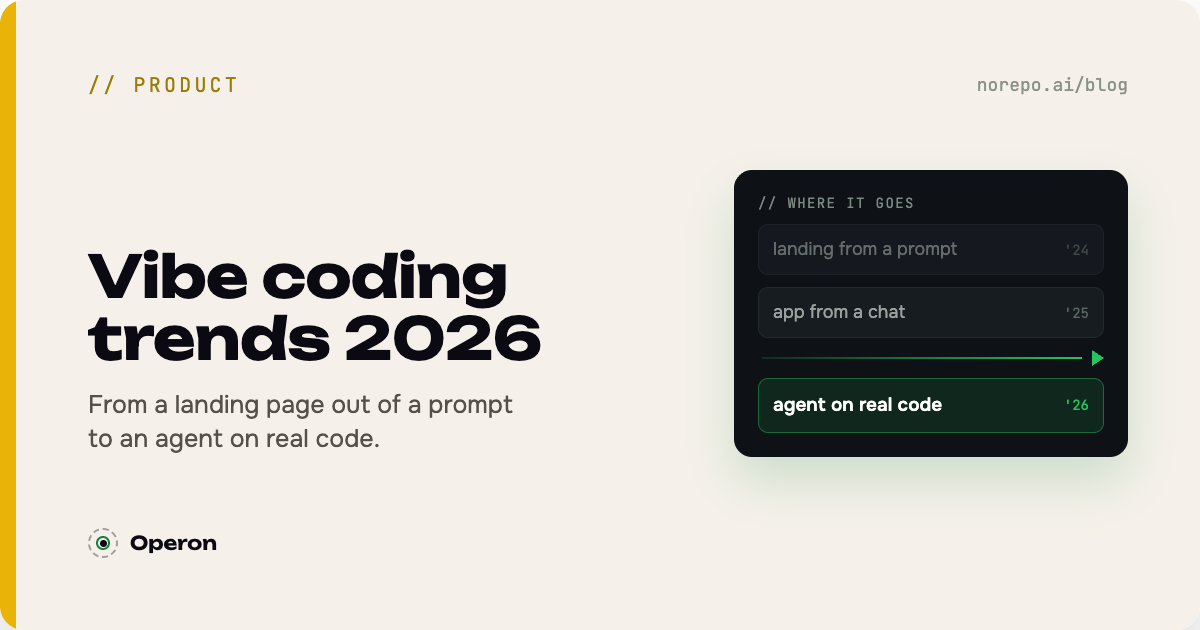
A couple of years ago, vibe coding meant "assemble a landing page or prototype from a prompt in an evening." Today that's just the starting point. The tools grew up, and with them the question shifted: not "what can I generate fast" but "what can I take to a working product and hold there." Let's break down the four trends defining vibe coding in 2026 and what follows from them in practice.
Trend 1: from app builders to agents on real code
The first wave of vibe coding was builders assembling an app from a description. That hasn't gone anywhere and works well for a start. But the emphasis shifted from "assemble a new app" to "run work on existing code."
The difference is fundamental. Building an MVP from a prompt is a one-off act. A product after launch lives as a stream of daily changes: features, bug fixes, integrations. Here it's not builders that come to the front but agents that take a task, read the repo, write, test and open a pull request. The trend isn't "generate an app" but "hand an agent a stream of tasks on live code." What such an agent is, we covered separately: what is an AI dev agent.
Trend 2: products with an agent inside
The second shift is from "vibe-code an app" to "vibe-code a product with an agent working inside it." AI used to be a build tool. Now it increasingly becomes part of the product itself.
A live example is agentic commerce: a service where an AI agent handles the purchase in chat. The user describes what to buy in words, the agent searches the catalog, compares suppliers, shows the price and drives to payment. It's not an app assembled from a prompt but a product where the agent isn't a build tool but an actor. There will be more such products: the agent in the interface stops being a gimmick and becomes the way the product works at all.
Trend 3: the non-technical person as briefer, not client
The third trend is about roles. A person without code used to be a client: describe what's needed and wait for a developer. Now the line shifts: the non-technical person becomes a briefer and accepter.
They state the task in words, and an agent handles execution. What's required of the human isn't writing code but formulating the task clearly and accepting the result against criteria. That's a skill, and its quality directly determines what the agent returns. How to brief tasks so an agent finishes them is in how to brief an AI agent. The trend is that the entry threshold to building a product moved from "I can write code" to "I can brief clearly and accept work."
Trend 4: review as the new bottleneck
The fourth and most underrated trend. When agents write the code, the volume grows faster than a human can read it. Writing stops being the bottleneck — acceptance becomes it.
From this follows a shift in priority. Generation speed used to be prized: who ships faster. Now the prize goes to the process that lets you accept an agent's work without reading every line: criteria, diff, tests, preview. The review gate isn't bureaucracy but what makes agent-driven development manageable at all. How to accept an agent's work in five minutes, we covered separately: a review checklist for an AI agent's work.
What follows in practice
Put the four trends together and a clear picture emerges of what you can actually vibe-code in 2026. Builders remain for a quick start — MVPs, landings, prototypes. But anything that lives beyond launch needs not generation but a process: a board, executor agents, review. And the most interesting thing today is products with an agent working inside, because that's the next level, not just "a site from a prompt."
The practical takeaway for a founder: don't chase generation speed, build an acceptance process. The winner isn't whoever generated faster but whoever held quality across the stream. On where vibe assembly ends and production work begins, see vibe coding: great until it's time for prod.
What not to expect from vibe coding
Honestly about the flip side of the trends, so as not to set expectations too high. Vibe coding doesn't cancel engineering. It removes routine but doesn't replace thinking through architecture, security and complex decisions — where there's a lot of ambiguity, a human is still needed. A product assembled without a single view of how it works inside eventually hits a wall no extra prompt can break.
Don't expect "10x overnight" either. The speed of building the first version really did grow many times over, but the path from demo to a stable product is made of the same acceptances, tests and fixes — only agents now perform them. The trend isn't that thinking became unnecessary, but that the thinking now goes into briefing and acceptance rather than writing every line. Whoever confuses these gets a fast prototype and a slow disappointment.
Bottom line
- The emphasis shifted from app builders to agents working on real code.
- A class of products with an agent working inside is growing — agentic commerce, for example.
- The non-technical role is changing: they become a briefer and accepter, not a client.
- The bottleneck moved from writing to acceptance — a process with review wins, not generation speed.
Start free: 2 tasks a week, no card — norepo.ai. See how it works on the product page.