What Is an AI Dev Agent — and How It Differs From a Chatbot
An agent doesn't 'suggest code' — it takes a task, reads the repo, writes, tests and opens a PR. In plain words: what an AI dev agent is and where its limits are.
Operon Editorial, Team ·
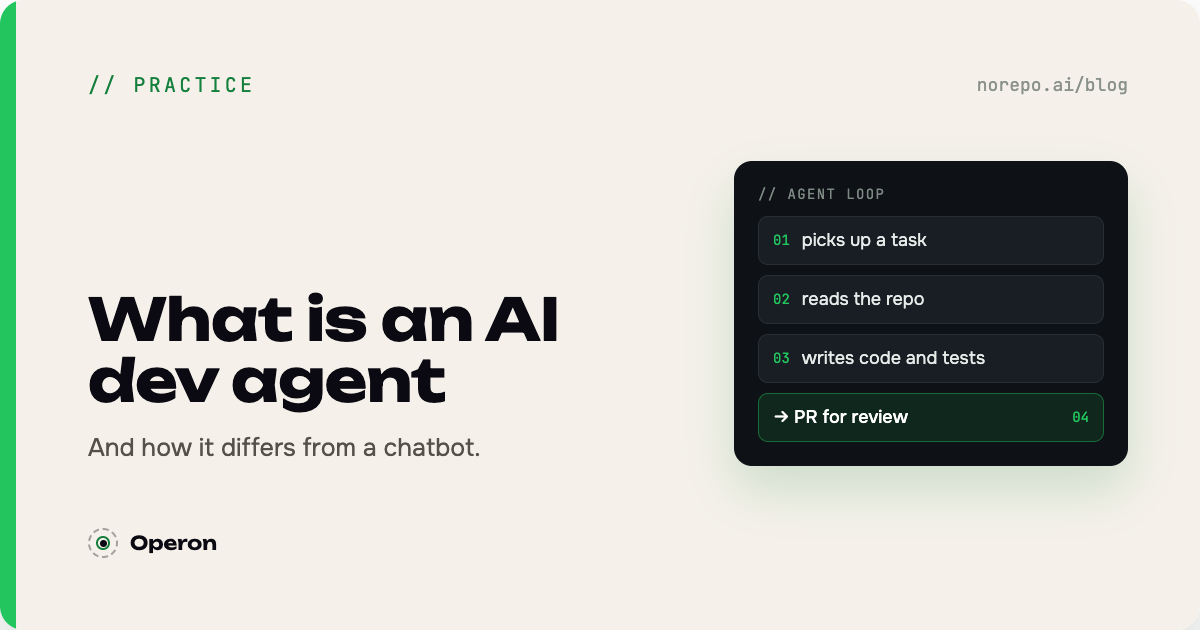
An AI dev agent isn't a "code suggester" — it's an executor: it takes a whole task, reads the repo, writes and fixes code, runs tests and opens a pull request. Unlike a chatbot that answers a question, an agent drives the task to a finished result, and you accept it at review. Let's explain in plain words how an agent differs from familiar tools, what it does step by step, and where its limits are.
Chatbot, autocomplete and agent — the difference
Three things that are easy to confuse but sit at different levels.
- A chatbot answers a question — "how do I do X" — and gives text or a code sample. You do the rest.
- Autocomplete (as in the IDE) suggests the next line while you write yourself.
- An agent takes a task and does it itself: reads the code, plans, writes, tests, opens a PR. You set the goal — you get a result.
The key difference: the first two help you work; the third works instead of you on a scoped task.
What a dev agent does, step by step
A typical cycle looks like this:
- Takes the task — with acceptance criteria and context (which files, what not to touch).
- Reads the repo — understands structure and dependencies rather than writing blind.
- Plans and writes code — makes changes, across several files if needed.
- Runs tests — checks it didn't break existing behavior.
- Opens a pull request — packages the change for review instead of merging itself.
That's exactly why an agent is placed not "instead of a developer altogether" but on a stream of routine tasks.
What an agent can and can't do
Honestly about the limits. An agent is strong on well-scoped tasks: forms, integrations, bug fixes, landing pages, scripts, routine features. Here it's predictable and fast. Where it stalls: architecture, highly ambiguous work, product forks — there you need a human to brief the task and accept the result. The good news: briefing is a skill, and the agent's result depends directly on its quality. More on that: how to brief an AI agent.
How to fit an agent into your workflow
An agent shines not alone but in a "board + review" loop. A task is stated in words, moves onto the kanban, goes to the agent, comes back to Review — and a human accepts it against the criteria. You keep quality control without doing the routine by hand. If you're currently assembling demos with prompts and hitting a ceiling, moving to agents is the next step — see vibe coding: great until it's time for prod.
Bottom line
- An AI dev agent takes a whole task: reads the repo, writes, tests, opens a PR.
- That's fundamentally more than a chatbot or autocomplete, which only help you.
- An agent is strong on scoped tasks; architecture and ambiguity need a human.
- It works via branches and pull requests with mandatory review — safe and controllable.
Start free: 2 tasks a week, no card — norepo.ai. See how it works for founders on the founders page.