Cursor vs Claude Code vs Operon: How to Run a Fleet of Agents
Cursor is AI in the editor, Claude Code is an agent in the terminal, Operon is a board with a fleet of agents and review. Where each is strong, and how they stack.
Operon Editorial, Team ·
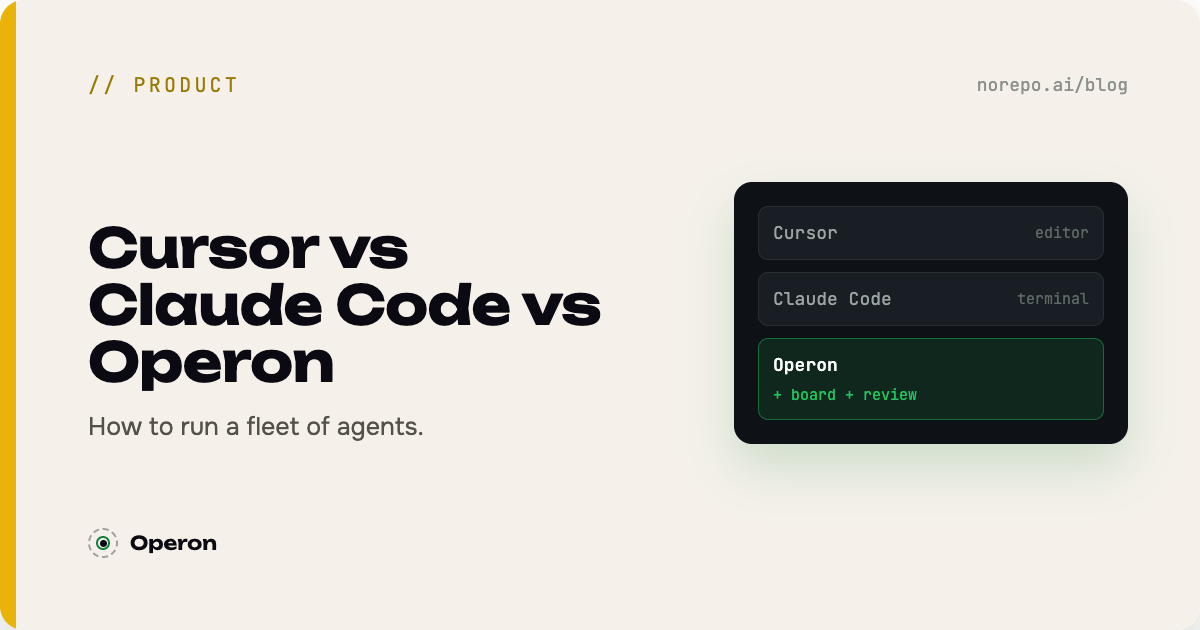
Cursor, Claude Code and Operon are often lumped together, but they sit at different levels: Cursor is AI in the editor, Claude Code is an autonomous terminal agent, Operon is an orchestration board with a fleet of agents and acceptance. They don't so much compete as stack. Let's be honest about where each is strong and how they fit together.
Cursor: AI in the editor
Cursor is a code editor with built-in AI. You work by hand in a familiar IDE while the model completes code, explains, refactors, and in agent mode can take a few steps on its own. Cursor's strength is close contact with the code: you see everything happening and keep your hand on the pulse. It's the best choice when you write and want to go faster, rather than delegate a task wholesale.
Claude Code: an agent in the terminal
Claude Code is an agent that lives in the terminal. You state a task and it reads the repo, plans, writes and fixes code, runs tests. This isn't an "assistant in the editor" — it's an autonomous executor: you set a goal and get a result, not line-by-line suggestions. Claude Code shines when a task can be scoped and handed off whole.
Operon: a board and a fleet of agents
A single terminal agent works great while you drive one task and sit next to it. Problems begin when tasks are many, run in parallel, and acceptance involves more than just you. That's where you need a layer on top — an orchestrator. Operon is a board where:
- a task is stated in chat in words, and the AI sharpens the criteria;
- the card moves onto the kanban;
- the executor becomes an agent (including Claude Code via MCP);
- finished work returns to Review, and you accept it against the criteria.
So Operon doesn't write code instead of Claude Code — it runs a fleet of such agents and adds the acceptance a lone agent lacks.
When to choose what
| Tool | Level | When to choose |
|---|---|---|
| Cursor | AI in the IDE | you code by hand and want a boost |
| Claude Code | agent in the terminal | a task can be scoped and handed off whole |
| Operon | orchestration board | many parallel tasks, you need a board and acceptance, a non-technical stakeholder is involved |
How they stack
The right picture isn't either/or — it's a stack. Cursor and Claude Code are execution tools. Operon is the control layer: it hands tasks to agents, keeps the kanban and review gate, and escalates stuck questions. How to brief tasks so an agent finishes them, we covered separately: how to brief an AI agent. And why a board with agents beats a plain tracker is in how to replace Jira in 2026.
Bottom line
- Cursor — AI in the editor for those who write by hand.
- Claude Code — an autonomous terminal agent for scoped tasks.
- Operon — an orchestration board: a fleet of agents + kanban + review gate.
- They're not competitors but a stack: execution tools below, flow control on top.
Start free: 2 tasks a week, no card — norepo.ai. See it for a team on the business page.