How to Brief an AI Agent So It Actually Finishes the Task
An agent writes code faster than you can specify. The bottleneck is the brief. Here's what a task an agent actually ships to review is made of.
Operon Editorial, Team ·
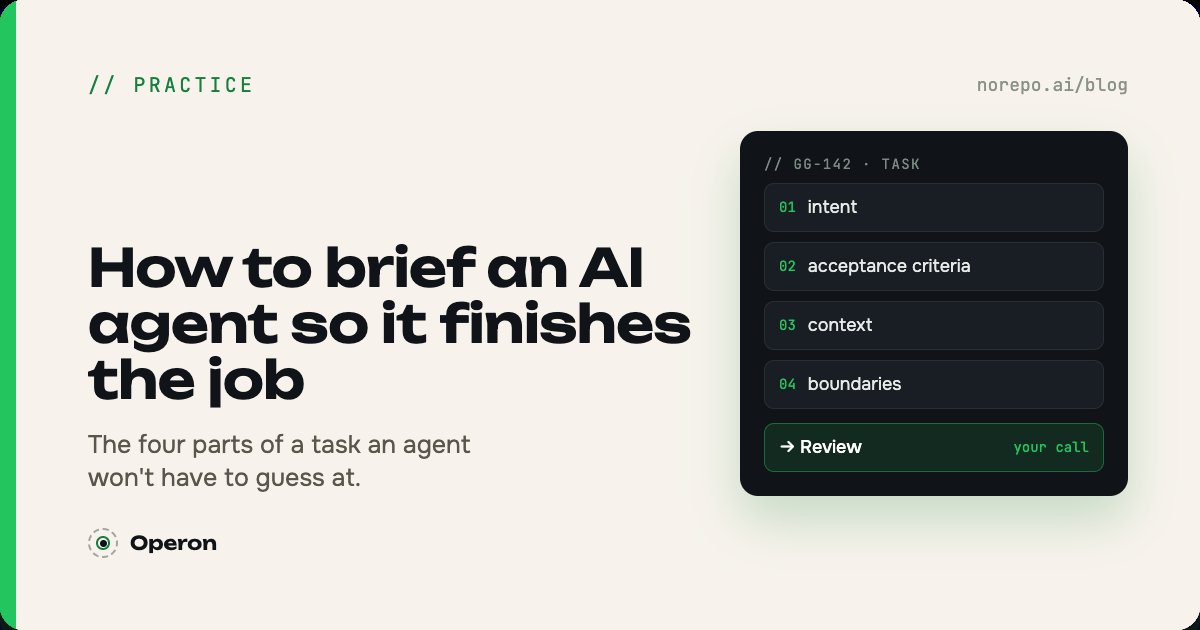
An AI agent writes code faster than you can feed it tasks. So the development bottleneck in 2026 isn't "writing" — it's "specifying and assigning". The good news: briefing is a skill with a clear structure. Here's what a task an agent like Claude Code actually ships to review is made of, and how to accept the result without drowning in rewrites.
Why the brief became the bottleneck
Writing code used to be the most expensive part of the cycle. Now an agent does it in minutes — and idles while you specify the next task. If the task is vague, the agent fills the gaps and confidently does the wrong thing. One tasklet gets rewritten four times, and criteria get invented in the code. The fix isn't "prompt magic" — it's briefing discipline.
What a good task for an agent is made of
- Intent. What and why, in a sentence or two. Not "fix the form" but "add email validation and a captcha to the sign-up form to block bots".
- Acceptance criteria. How we'll know it's done — concrete and checkable: "email validated per RFC", "empty field shows a clear error".
- Context. Links to the relevant files, examples, constraints, dependencies. The less the agent guesses, the fewer misses.
- Boundaries. What NOT to touch. An explicit scope reduces the risk of the agent rewriting half the project "while it's at it".
Avoiding mush: acceptance criteria without fluff
The main mistake is criteria like "do it well". The agent takes them literally, so make them checkable: input, expected result, edge cases. It also helps to have the agent ask first rather than generalize. In Operon that's the draft mode: the model either carries facts over one-to-one or asks a clarifying question, and you confirm the final version with a button.
The review gate: the agent submits, you accept
The agent shouldn't merge on its own. The right cycle is a review gate: the agent writes the code and moves the card to Review, and a human accepts the work against those acceptance criteria. You keep quality control without micromanaging — open the board and the finished work is waiting for your "yes".
What to do when the agent gets stuck
A silent agent is worse than a slow one. If it has an unanswered question, the task shouldn't hang — you need escalation. In Operon that's escalating pings: after an hour, six hours, a day, respecting quiet hours. The point is the question always surfaces instead of sinking.
Bottom line
- The bottleneck shifted from writing code to specifying tasks.
- A good task = intent + acceptance criteria + context + boundaries.
- Make criteria checkable; let the agent ask rather than assume.
- Accept work through a review gate: the agent submits to Review, the final "yes" is human.
- Set up question escalation so a stuck task doesn't get lost.
Want this on autopilot? Start a free board and try the loop: task in chat → agent on the board → review.