Who Needs Norepo Most — and Who It Honestly Isn't For
Norepo's main user isn't a programmer but a domain expert: someone who knows what the product should be. Three portraits, where the platform shines, and where it honestly stalls.
Operon Editorial, Team ·
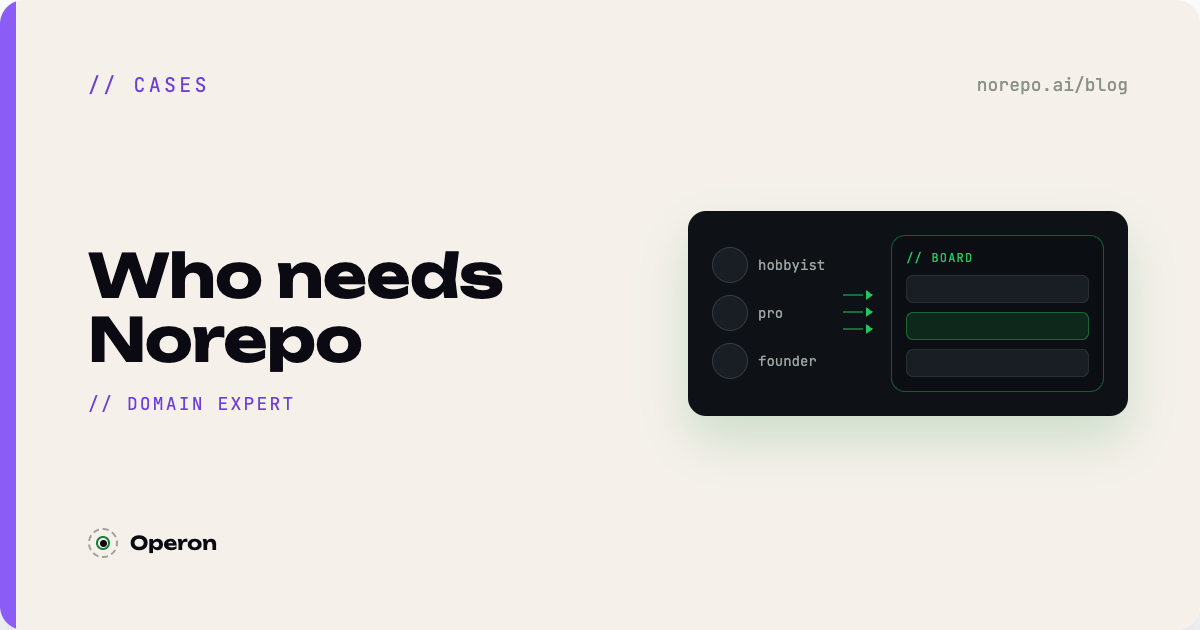
Norepo has a non-obvious main user. It's not a programmer or a "techie" looking to speed up. "For me the main target user of Operon is a domain expert," says the platform's co-creator, Sasha Shinov. "A person who knows what the product should be: as a user, as an industry worker, whoever." Let's be honest about who gets the most out of Norepo, where it shines, and where it stalls — so you either recognize yourself or realize it isn't for you yet.
Three portraits
By the team's observations, the value concentrates around three types of people.
The passionate hobbyist — someone into something who builds a product for people like them. Their pain is simple: they don't know how to turn a hobby into a product. The expertise is there; the path to realization isn't.
The professional with years of experience who wants their own business. Their pain is a lack of development resources: no time, no adjacent expertise, no team. The understanding is there; the hands aren't.
The entrepreneur long building a product with a team. They know their market inside out but can't understand why their expertise doesn't turn into results. Their pain is low quality and speed: the resource exists but drains into a void.
What all three share is expertise with no channel to realization. That channel is exactly what Norepo provides.
The unexpected user — the developer himself
The most unexpected early user was the person you'd least expect — Shinov himself. "At first it didn't seem to me that I, a developer with a lot of experience, would find such a product useful. But it gives not only code. It gives organization of the process, context, control, time saved."
That's an important nuance: Norepo isn't "code replacement for those who can't," but a way to organize work. So it lands even with those who can code but don't want to spend themselves on routine and context management.
Where Norepo shines
The platform is strongest where there's good documentation and few dependencies on third-party products. "The less tied to others' services, the better," says Shinov. "Unfortunately, those you need to integrate with often don't work the way it's documented." That's honest mechanics: an agent acts great on clear context and stumbles where the outside world behaves off-spec.
How to brief tasks so an agent finishes them, we covered separately: how to brief an AI agent.
Where it honestly stalls
A paradox: Norepo does the complex better than the simple. "It can build very complex architecture and really cool solutions. It's harder with simple things," Shinov admits. "Like any AI, it'll happily invent filler, write texts that make you want to either cry or laugh, and leave 'for later' stubs. We fight this, but sometimes it slips through."
Hence a direct warning from the team: Norepo isn't a magic wand or a panacea. "It's a working tool, even if one trying to make development far more accessible. You have to check the result carefully and not be lazy about sending tasks back for rework." Why acceptance becomes the key skill is in the breakdown a review checklist for an AI agent's work.
The technical ceiling
On the stack there are almost no limits. "What a decent human developer can write, Operon can too, if you explain the task clearly. It wrote in C/C++ for me and did all sorts of things," Shinov says.
But here are the honest boundaries worth knowing up front. The most significant is mobile apps: they can't yet be run in preview mode, and the infrastructure has no Apple devices, so Operon won't build an iPhone app. And it won't publish your app to the store — that's a legal question more than a technical one. If your project is a native mobile app, factor this in before you start.
What's required of the user
The requirements are minimal. "Nothing is mandatory except understanding what you want to get. For the rest, there's Operon," Shinov puts it. The team deliberately tries to make the task-writing skill optional: you can discuss a task in chat with a planner and it will phrase it for you. But a basic understanding of what you're doing is still needed.
And the main condition is participation. "If a person isn't ready to work with Operon at least sometimes, nothing will come of it. Operon's user is the product's creator. If you spend even five minutes a day, there's already a chance of success: look at what's coming out, give corrections, set new tasks." Whoever expects a result with no involvement won't get one, and it's honest to know that in advance. What the start looks like from the user's side is in the guide how to start a project in Norepo.
Team or solo
For a team the value spreads across roles. "It's unlikely to be just a crowd of people — everyone has their own interests: marketing needs one thing, sales another, product a third. It's like a dev department in a company." For a solo founder Norepo covers all these roles at once.
On payback the team is blunt: "Operon pays off immediately. Even the most expensive plan is cheaper than one programmer. Cheaper than one bad programmer — and it works faster and more transparently." It especially pays off where an old product is easier to rewrite than fix: "Operon struggles with ancient legacy products, but it easily rewrites a product from scratch — we've tested this on old, large products." How the cost of ownership works out in money is in the breakdown pricing: Norepo, Lovable, Base44 and Claude.
Bottom line
- Norepo's main user is a domain expert, not a programmer: a hobbyist, a professional, or an entrepreneur with a team.
- It lands even with experienced developers — for the organization, context and time saved, not only the code.
- Honest boundaries: it stalls on simple things and filler, doesn't build mobile apps and won't publish to the store.
- Little is needed — an understanding of what you want and at least five minutes of involvement a day; it pays off immediately, cheaper than one programmer.
Start free: 2 tasks a week, no card — norepo.ai. See how it works for a founder on the founders page.