Lovable vs Base44 vs Norepo: App Builders and an Agent Board Aren't the Same Thing
Lovable and Base44 build an app from a prompt. Norepo doesn't build an app — it runs a fleet of agents on your repo. An honest look at where these are different tools and how they stack.
Operon Editorial, Team ·
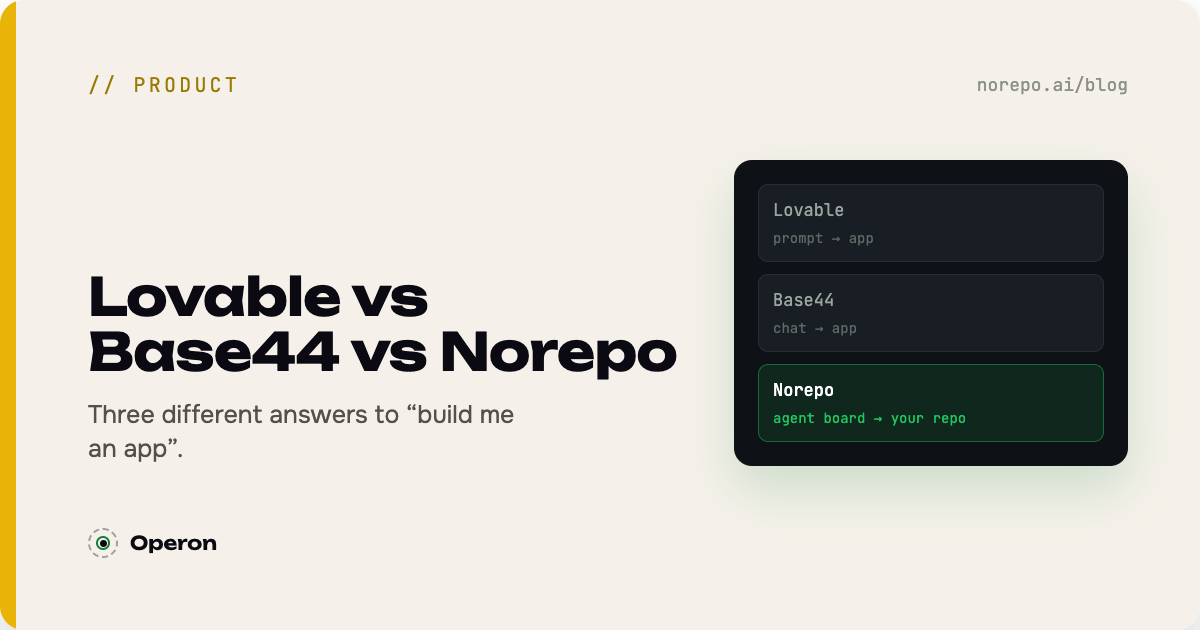
Lovable, Base44 and Norepo often land in the same "vibe-coding tools" list, but they serve different purposes. Lovable and Base44 assemble an app from a text description — you say what you want and get a working product. Norepo doesn't assemble an app: it orchestrates a fleet of AI agents that execute tasks on your existing code. They're easy to confuse and expensive to pick wrong. Let's be honest about what each does and how they fit together.
Lovable: a prompt becomes an app
Lovable is a platform that turns a text prompt into a finished full-stack app: a React frontend, a database and auth on Supabase, payments via Stripe, deployed to a subdomain. You describe what you need and in minutes get a working product, not a scaffold. This approach is what popularized the term "vibe coding" in the first place.
The model is credit-based: a free tier with a daily cap, Pro at $25 a month, Business at $50. Each message to the agent spends credits depending on complexity. The audience is hundreds of thousands of builders, from founders to marketers, who need to ship a working app fast without a dev team.
Base44: a chat builder the big players noticed
Base44 solves a similar problem through a different interface: a fully chat-driven no-code builder that hides the database, auth and deploy behind the scenes. The user describes the app in words, and the system handles the technical details.
Base44's story is telling: in June 2025 Wix acquired it for around $80 million, with a team of about six people and a quarter-million users at the time. That's not just deal news — it's an illustration that the builder market is real and big players are entering it seriously. What matters for us is different: both Lovable and Base44 belong to the same class — they create an app from a prompt.
The shared limit of builders
Builders have a natural boundary, and it's not about quality but about scenario. A builder is strong when the app doesn't exist yet: spin up an MVP, a landing page, an internal tool, a prototype for an investor. You get a new product from a description — that's its job.
Difficulties start once the product already exists and lives its own life: its own repository, its own commit history, its own review requirements, a stream of dozens of tasks a week on real code. Here the "describe an app — get an app" model no longer fits. You don't need to "rebuild from scratch" but to run a stream of changes on existing code under control. That's a different job — and a different tool.
Norepo: not a builder but a board with a fleet of agents
Norepo sits at a different level. It doesn't assemble an app from a prompt — it orchestrates AI agents that execute tasks on your existing repository. A task is stated in words in chat, the AI sharpens the acceptance criteria, the card moves onto the kanban, and an agent becomes the executor: it reads the code, writes, tests and opens a pull request. Finished work returns to Review, and a human accepts it against the criteria.
The difference is fundamental. A builder gives you an entire app at once. Norepo gives you a controlled stream of tasks on an already-live product, with mandatory review before merge. It doesn't compete with a builder over "assembling an MVP" — it covers what starts afterward: the daily work on real code done by agents but under human control. More on the transition from prompt-assembly to production work in the breakdown vibe coding: great until it's time for prod.
When to choose what
| Tool | What it does | When to choose |
|---|---|---|
| Lovable | prompt → full-stack app | you need to build a new app or landing fast |
| Base44 | chat app builder (no-code) | same, if a pure chat interface fits better |
| Norepo | agent orchestration board on your repo | a stream of tasks on existing code, review and control needed |
How they stack
The right picture isn't either/or but a sequence. First a builder quickly assembles the first version of the product from a prompt. Once the product takes off and turns into a stream of daily changes on real code, the work is better run on an agent board with acceptance — where review, criteria and change history matter. How to brief tasks so an agent finishes them, we covered separately: how to brief an AI agent. And why an agent board beats a plain tracker on a task stream is in how to replace Jira in 2026.
It's worth keeping in mind that vibe coding builds more than web apps. Agentic products are built this way too — for example a service where an AI agent handles the purchase in chat: also a product grown from the "describe it in words — get a result" idea, only applied to buying rather than to assembling an interface.
Bottom line
- Lovable and Base44 are builders: they assemble a new app from a prompt.
- Norepo is not a builder but an orchestration board for agents on your existing code.
- Choose by scenario: build a product from scratch — a builder; run a task stream with review — Norepo.
- A logical stack: a builder to start, an agent board once the product grows into daily code work.
Start free: 2 tasks a week, no card — norepo.ai. See it for a team on the business page.