Products Vibe-Coded Solo: Who Ships What With Tiny Teams
Base44 — one founder, a team of six, sold to Wix for $80 million. A look at what solo entrepreneurs actually build with vibe coding and where the model hits a ceiling.
Operon Editorial, Team ·
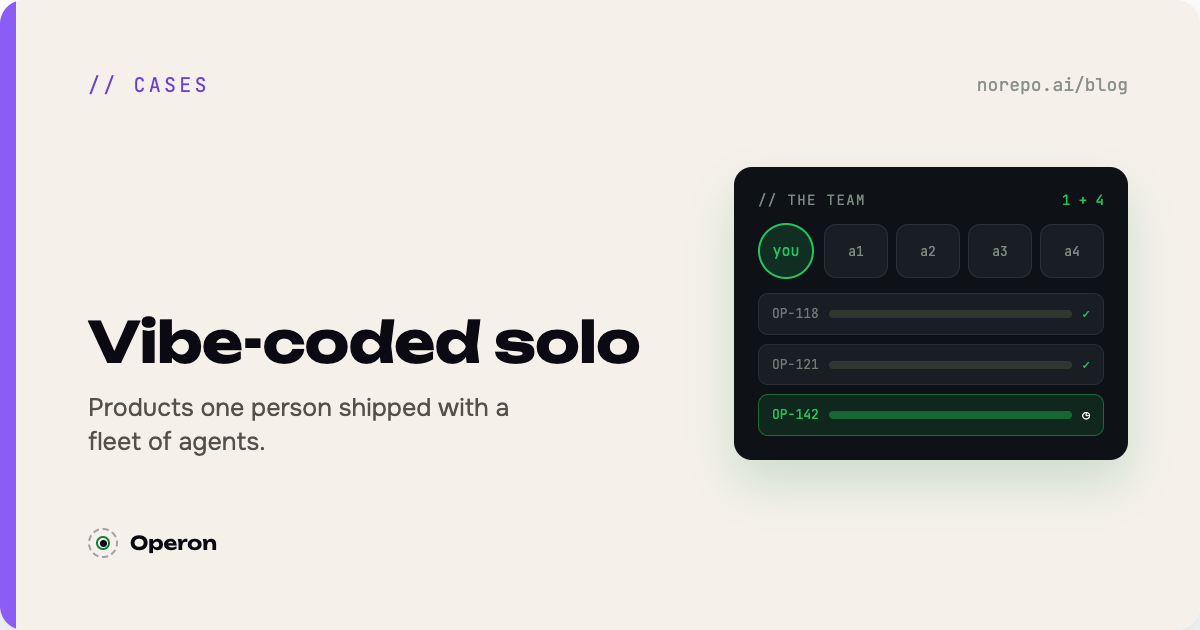
Shipping a product used to require a team: a frontend dev, a backend dev, a designer, someone for infrastructure. In 2026 one person or a team of a few increasingly does it. Not because it's trendy, but because builders and AI agents removed most of the routine that required the headcount in the first place. Let's look at specifics of what solo entrepreneurs actually build, and honestly, where the model hits a ceiling.
The case that became a symbol: Base44
The loudest example is Base44. It's a chat app builder: the user describes a product in words and the system hides the database, auth and deploy behind the scenes. In June 2025 Wix acquired it for around $80 million.
The details matter. The product grew to a quarter-million users, the team at the time of the deal was about six people, and the company raised no external funding. A small group of people built a product a large company valued at tens of millions — and did it on exactly the approach now called vibe coding. Base44 is an extreme example, but it shows the ceiling of what's possible, not a lucky fluke.
Why this became possible at all
Behind solo products is a simple mechanic: tools took over the routine. Builders like the ones that popularized vibe coding assemble a working app from a prompt — frontend, database, payments, deploy. AI agents take on writing and fixing code on an already-existing product. What used to take a team weeks is now done in hours by one person and their agents.
This doesn't mean "developers aren't needed." It means one developer — or a founder without a deep technical background — covers volume that used to need several. What an agent that takes a task and drives it to a result actually is, we covered separately: what is an AI dev agent.
What you can actually vibe-code solo
Strip the hype and solo products fall into a few categories.
Internal tools — admin panels, dashboards, process automations companies previously skipped because they were too expensive. Niche SaaS — a narrow product for a specific pain, where you don't need a big team to reach the audience. Landing-page products — something that's both a storefront and a working service. And separately — agentic products, where the product itself is built around an AI agent.
That last category is the most interesting, because it's the next turn: not just assembling an app, but assembling a product with an agent working inside it.
Our example: agentic commerce with small effort
A telling live example from this category is a service where an AI agent handles the purchase in chat. The user writes what they want to buy in words, the agent searches the catalog, compares suppliers, shows the region and final price and drives to payment. It's not an app builder but an agentic-commerce product — and it too was built by a small team on top of already-working infrastructure.
The value of such an example is that it shows vibe coding builds more than web apps from a prompt — it builds products with their own complex logic, provided the team has a process that holds quality.
Where the solo model hits a ceiling
Honestly about the boundary. While the product is small, one person carries everything: briefing, writing, acceptance. The problem comes with success. When the product takes off, a stream of daily tasks on real code appears — and holding that stream alone while also accepting quality gets hard. The temptation is to hire a team and return to what you left behind.
The alternative is not to bloat headcount for routine but to set up a process. Tasks are stated in words, agents become the executors, and the human stays on briefing and review. That way a small team covers a big team's volume without becoming one. On exactly where vibe assembly ends and production work begins, see the breakdown vibe coding: great until it's time for prod.
That's the role an orchestration board fills — holding the task stream on real code via agents under review. A solo founder doesn't hire a team but hands tasks to agents and accepts the result against criteria.
What separates a successful solo product from an abandoned one
Not every solo product survives to reach users. The difference is usually not the idea or the build speed but what happens after the first demo. Abandoned projects almost always hit the same wall: assembling from a prompt worked, but maintaining and extending it alone didn't. The accumulated code becomes unclear even to its author, every edit breaks something nearby, and the drive fades.
Successful products are marked by having a process before it was needed. Tasks are stated explicitly, changes go through a check, and the founder doesn't carry the routine by hand. Then the product survives the "the first excitement wore off" stage and turns into a working service. At exactly this stage solo development either sets up a process with agents and review, or quietly dies under the weight of its own code.
Bottom line
- Products are increasingly built solo or by a tiny team — Base44's $80M sale to Wix proves it.
- Builders and AI agents made it possible by taking over the routine.
- What you can vibe-code: internal tools, niche SaaS, landing-page products and agentic services.
- The solo model's ceiling is the task stream as it grows; the answer isn't hiring but a process with agents and review.
Start free: 2 tasks a week, no card — norepo.ai. See it for a founder on the founders page.