Russian Task Trackers vs Operon: Where Tasks Also Get Done
Weeek, Kaiten, YouGile, Yandex Tracker — a look at the Russian trackers replacing Jira. And Operon's key difference: a board where tasks aren't just stored but done.
Operon Editorial, Team ·
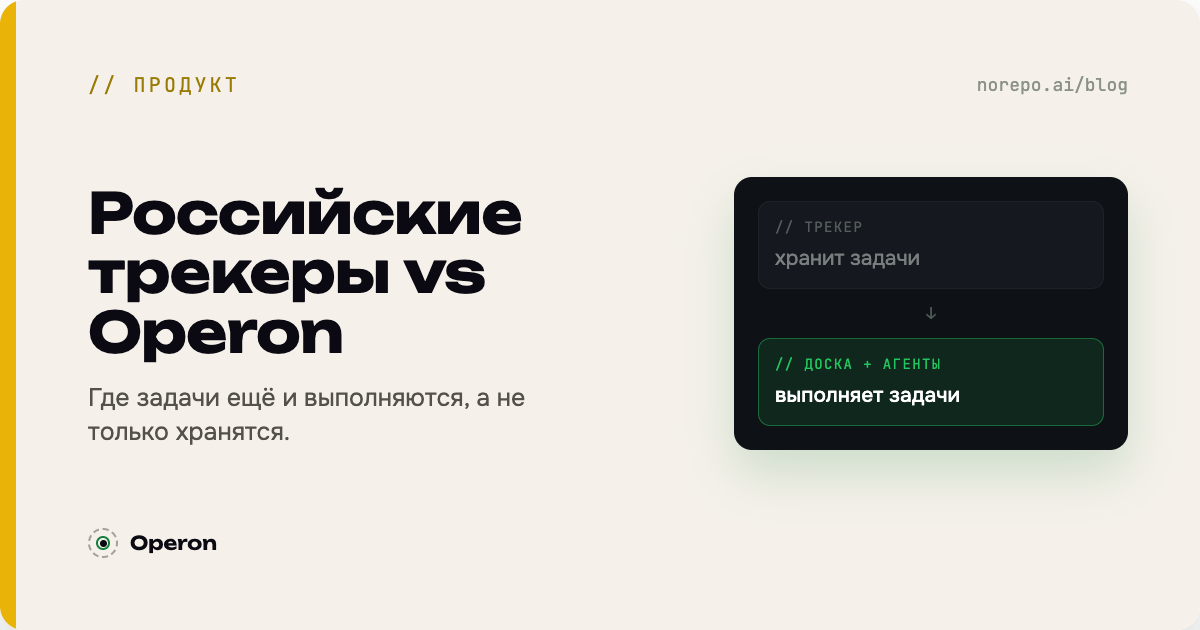
After Atlassian left Russia, teams have been scrambling to replace Jira — and the Russian tracker market has grown: Yandex Tracker, Weeek, Kaiten, YouGile and others cover the basic need of "somewhere to track tasks." But they all share one trait: they store tasks, while people still do them. Operon stands apart — it's a board where part of the tasks also get done by AI agents. Let's look at the Russian options honestly and show the fundamental difference.
Russian trackers: who's who
Short and to the point — what each is built for.
- Yandex Tracker — closest to Jira in spirit: flexible processes, queues, integrations inside the Yandex ecosystem. Good for mid-size and large teams that need process rigor.
- Weeek — lightweight product management: tasks, kanban, docs and CRM in one. Handy for small teams that want "all in one" without Jira's weight.
- Kaiten — focused on kanban and workflow, flexible boards and metrics. Fits teams that live by the kanban method.
- YouGile — kanban with a built-in chat on every task: useful where discussion and task should sit together.
They all solve "bring order to the work." Choosing between them is a matter of team size, process and interface taste.
What they share — and where the ceiling is
They share one important thing: a tracker shows the work but doesn't do it. You still hire people, assign tasks, wait for delivery and review. The bottleneck of modern development long ago moved from "write the code" to "specify, hand off and wait" — and a classic tracker doesn't close that part. It makes the queue transparent but doesn't speed up the work itself.
How Operon's approach differs
Operon isn't "another tracker instead of Jira" — it's a different class of tool: a board as the interface between people and agents. The mechanics:
- A task is stated in chat in plain words; AI sharpens the wording and acceptance criteria.
- The card moves onto the kanban — like in any tracker.
- Then an agent becomes the executor: Claude Code takes the task via MCP and writes the code.
- Finished work returns to the Review column — you accept it against the criteria.
So the board stays familiar, but part of the task stream closes without hiring. More on the shift itself in how to replace Jira in 2026.
The comparison that matters
| Tool | What it does | Who does the tasks |
|---|---|---|
| Yandex Tracker | process tracker | people |
| Weeek | all-in-one for small teams | people |
| Kaiten | kanban and flow metrics | people |
| YouGile | kanban + chat on the task | people |
| Operon | board + a fleet of AI agents | agents + a human at review |
This doesn't mean the Russian trackers are bad — they do their job well. It's just that their job ends where yours begins: actually getting the tasks done.
Who should pick what
- You need process rigor and run a large team of people — take Yandex Tracker or Kaiten.
- Small team that wants "all in one" — Weeek or YouGile.
- You want the routine task stream (forms, integrations, bug fixes, landing pages) closed without hiring — that's the Operon scenario; it also has a tracker board, and it's free.
Bottom line
- The Russian tracker market covers Jira's role: Yandex Tracker, Weeek, Kaiten, YouGile are workable options.
- But they all store tasks, while people do them.
- Operon is a different class: a board where part of the tasks are done by AI agents, with a human accepting the work at review.
- The choice depends on what you need: order in the queue — a tracker; speed in the doing — a board with agents.
Start free: 2 tasks a week, no card — norepo.ai. See how it works for teams on the business page.