How to Start a Project in Norepo: An Honest First-Launch Guide
Not 'talk for a day, get a business.' A step-by-step on how to start a project in Norepo: what to prepare, why the first step is context and the first task is a landing page, and why the main bottleneck is you.
Operon Editorial, Team ·
The scarcest resource today isn't money or engineers — it's entrepreneurial ability: seeing the customer, closing deals, assembling a business from an idea. Norepo shifts the key to success from those who can raise money for a large IT team to those who know the market and can brief tasks in words. But a new user often asks: so where do I start to avoid drowning? This guide is step by step, with honest expectations, drawn from the experience of those who already went through the first launch.
First — the right mindset
The first thing to accept before any button: Norepo doesn't turn three sentences into a working business. A product always consists of features, of differences from competitors, of details you have to think through and earn. What the platform gives is something else — speed and quality of execution that let you keep focus and interest in the project while it comes together.
So the right mindset sounds like this: you're still building the product, agents just take over executing the routine while you stay on briefing and acceptance. Whoever expects "a business in one day" will be disappointed. Whoever expects months of team work to compress into hours gets exactly that.
What to prepare before you start
The technical minimum is small: a GitHub account and a repository where the project will live. An active Claude subscription is highly desirable — and here's why it's needed even before the first task.
At the start Claude works as your customer developer: it challenges the idea, helps clarify what you're actually building and for whom. It also helps sketch the architecture, describe features, think through design and even marketing strategy. All of this is the raw material from which specific tasks later appear on the Norepo board for agents to pick up. What an agent that takes a task and drives it to a result is, we covered separately: what is an AI dev agent.
Step one — not a task, but context
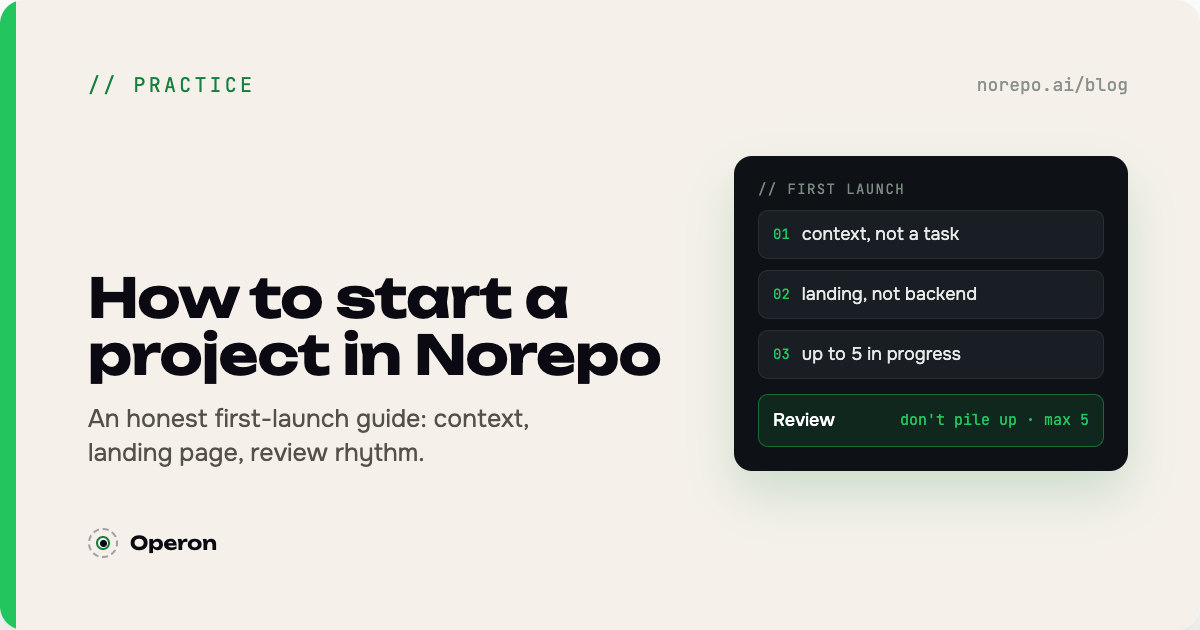
A beginner's mistake is to hand the agent a feature right away. The correct first step is to build context. Describe in words how the project is arranged: where the code lives, what database, what frontend and backend, in which languages. It sounds technical, but it's stated in plain words — you dictate, and the system turns it into documents.
In practice, such a description produces a set of short documents that become the project's foundation. From then on, each task rests on this context rather than hanging in a void. The more honest and complete the context at the start, the less the agent "fills in" and the closer the result is to what you intended.
The first task: start with something you can click
Once context is built, the question of the first working task arises. The best choice is something you'll see and touch on a preview stand right away. Everyone perceives things differently, but a project you can click from the first minutes feels entirely different from invisible logic inside.
The ideal first task is a landing or product page. The reason isn't only speed. A landing forces you to formulate a unique value proposition, think through the functionality users need, and look at the product through their eyes. The most dangerous thing for a founder is to fall in love with the product without grounds; a landing brings you back to earth, because that's where the first customers land and where you take the first feedback. When you describe a landing — with animation, pricing, a value description — you sell the product to both yourself and the market at once. That's a good start for the project and for you.
How to brief tasks so an agent finishes them, we covered separately: how to brief an AI agent.
Why not start with a complex backend
The temptation to start with the "serious" part — the backend architecture — is worth holding back. The backend isn't visible: it's hard to tell whether the project is heading the right way, and easy to lose touch with it as agents assemble it. First build the full architecture in your head and in documentation, discussing it thoroughly with Claude, so features are described and can be handed off.
The backend matters no less than the frontend — it's just that the first tasks are better made visual. That way you form a living connection with the project: you see it, show it to your team and family, take feedback and start to "befriend" your product rather than building it blind.
Rhythm and the main bottleneck — it's you
Here begins the most important and most underrated part. In agent-driven development the bottleneck isn't the agents but the human who accepts the work. Agents move tasks to review very fast, and the Review column fills faster than you can check. If you don't control this, quality leaks away.
The practical rule: keep roughly up to five tasks in progress and don't accumulate more than five in the Review column. Check what's delivered both with agents and yourself — click through the tasks by hand, bring in Claude and smarter models like Fable 5 to find bugs and vulnerabilities in what's moved to review. And don't run more than two projects at once: attention scatters, you remember your own ideas worse and lose focus. How to accept an agent's work fast and to the point is in the breakdown a review checklist for an AI agent's work.
The advice that saves weeks: don't pile up review. A clogged Review column isn't progress — it's lost control.
The moment it becomes clear this works
For Norepo's founder that moment came on the dev stand: a deployed version of the product — an agentic shopping service — began to quickly and accurately find the right items in a catalog of hundreds of thousands of digital positions, tell the buyer about them and drive toward a deal. And not by pushing, but by understanding the customer's need and working to make them return. "That's when it clicked: everything I'd planned came together and worked," he recalls. A live example of such a product is a service where an AI agent handles the purchase in chat, built on Norepo itself.
What to expect and not expect
Expect speed and quality: what took a team months a year or two ago, an agent inside Norepo does in minutes or hours — and completed tasks land in the project's memory rather than being forgotten. Don't expect a business from three sentences or a finished project in a day. The difference between "assemble a demo" and "take it to prod" we covered separately: vibe coding: great until it's time for prod.
Who it's for
Norepo suits solo entrepreneurs, founder teams and small IT companies already running more than one board and dozens of tasks in a tracker. It suits those who've had a dream project born and want to make the world a bit better. It suits those who tried to talk an app into being in Base44 or Lovable and hit a ceiling — there's a separate breakdown on the difference, Lovable vs Base44 vs Norepo. And it suits those who realized the software part of their business can and should be built by agents — and who feel the strength to create something new rather than endlessly work for someone else.
Bottom line
- Accept the mindset: Norepo speeds up execution, but you still build the product — from features and details.
- Prepare GitHub with a repository and a Claude subscription as a tool to sharpen the idea.
- Start not with a task but with context; make the first task a landing, not a backend.
- Keep up to five tasks in progress, don't pile up review, and don't run more than two projects at once.
Start free: 2 tasks a week, no card — norepo.ai. See how it works for a founder on the founders page.