What It Costs to Hire a Developer in 2026 — and When You Don't Need To
Real 2026 hiring numbers: salary, hidden costs and weeks of search. Plus the honest math of where an AI-agent subscription is cheaper — and where you still need a human.
Operon Editorial, Team ·
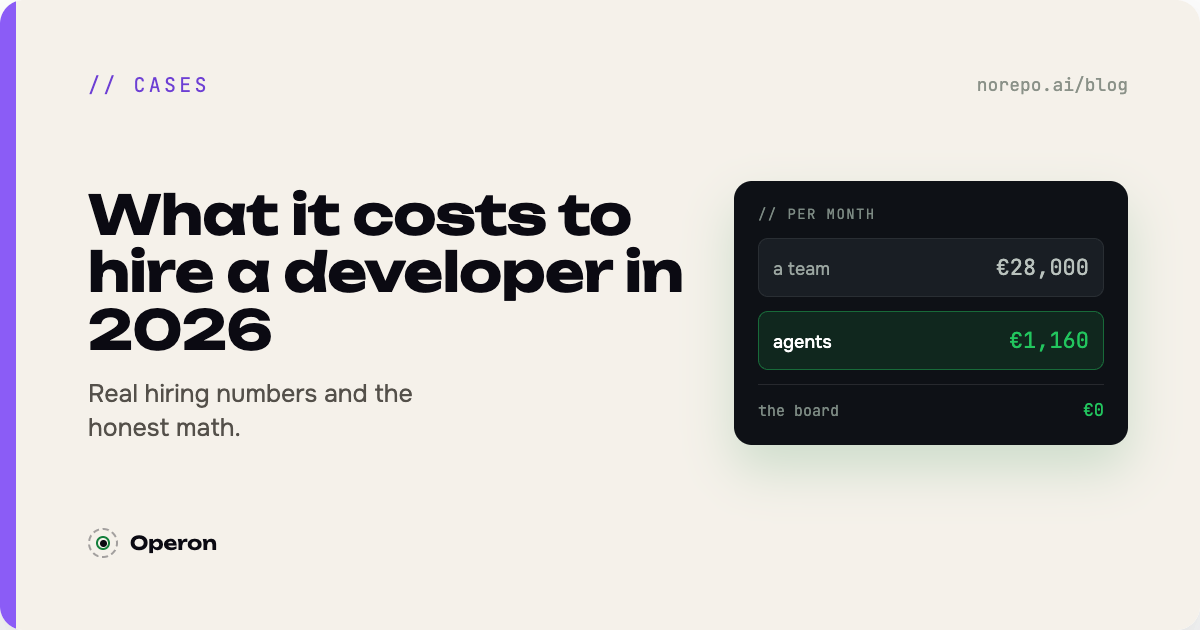
Hiring a developer in 2026 isn't just a salary: add taxes, equipment, weeks of searching and the risk of a failed probation. For a defined set of tasks an AI-agent subscription costs less — but not for everything. Here's the honest math: real hiring numbers, hidden costs, and where agents win versus where you still need a human.
What a developer really costs in 2026
Ranges depend heavily on stack and city (capitals pay 30–40% more), but the order of magnitude looks like this (Russian market, ₽/mo gross):
| Level | Salary, ₽/mo (gross) | Time to hire |
|---|---|---|
| Junior | 80,000 – 160,000 | 3–6 weeks |
| Middle | 200,000 – 280,000 (median ~240,000) | 4–8 weeks |
| Senior | from 350,000 | 6–10 weeks |
An agency or contractor charges more than an in-house hire because of their margin — but with no hiring. Still, salary isn't the full cost.
The hidden costs of hiring
The job-board number is only the tip. The real cost of an employee is roughly 40% higher and includes:
- Taxes and contributions — a significant markup on salary.
- Equipment and software — hardware, licenses, access.
- Onboarding and ramp-up — the first weeks are learning, not output.
- Management — specifying, reviewing and coordinating cost time too.
- Risk — a candidate may fail probation, and the cycle restarts.
When agents are cheaper — and when they're not
Honestly, agents don't replace everything. They're cheap and predictable on well-scoped tasks — forms, integrations, landing pages, bug fixes, scripts, routine features. Here the cost per closed task drops several times over.
Where you still need a human: architecture, highly ambiguous work, product forks, and requirements like SOC2, audit and regulation. The right model isn't "fire everyone" — it's handing agents the stream of routine tasks and freeing people for the hard parts.
The math: a human team vs an agent subscription
A rough but telling estimate for a routine task stream:
| Option | Cost per month |
|---|---|
| A human team of 8 on the same volume | ~€28,000 |
| Operon Agents (8 × €45) + your own model access (BYOK ≈ €800) | ~€1,160 |
| Operon board (kanban instead of a tracker) | €0 |
The proportions are real: the subscription pays for itself on the first task an agent closes. It doesn't mean people aren't needed — it means the routine stream is cheaper handed to agents, with expensive people placed on what truly requires a human. More on this shift in why one person with an AI agent outruns a team of four and the practice piece on closing dev tasks without hiring.
Bottom line
- A 2026 developer is salary (junior 80–160k, middle ~240k, senior from 350k ₽) plus ~40% hidden costs and weeks to hire.
- Agents are cheaper on well-scoped tasks: forms, integrations, landing pages, bug fixes.
- Humans are still needed for architecture, ambiguity and regulation.
- The sensible move: hand agents the routine stream and free people for the hard work.
Start free: 2 tasks a week, no card — norepo.ai. See how it works for small businesses on the founders page.