Why one person with an AI agent outpaces a team of four
For the first time in a decade, implementing tasks is no longer the most expensive part of the cycle. Specifying them is. Here's why, and what it changes for product owners.
Operon Editorial, Team ·
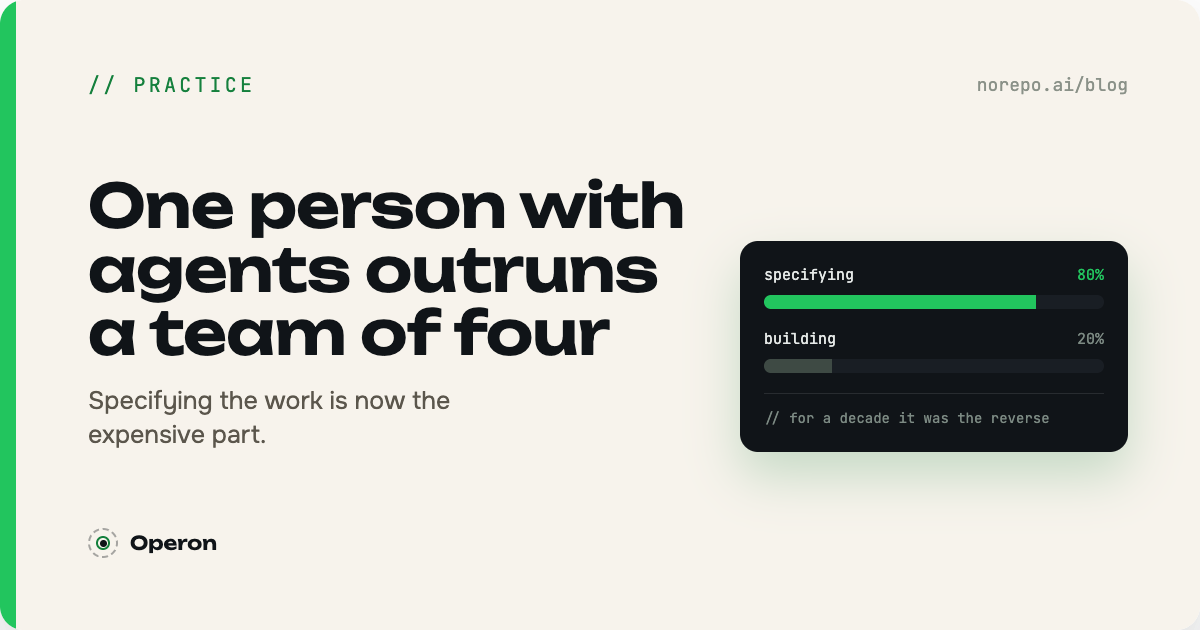
In most engineering teams, the bottleneck isn't the code — it's turning intent into a task. We've spent a year and a half watching how teams of every size actually work inside Operon, and the same pattern shows up over and over: roughly half of all tasks get reworked at least once before anyone gets around to doing them. The reason is thin context in the original framing, or an author trying to squeeze three unrelated actions into one ticket.
A significant share of a team's time goes not into implementation but into iterating on the understanding of what needs to be implemented. This slice of the work — specifying, decomposing, clarifying — becomes the bottleneck the moment the person doing the implementing speeds up. And it's precisely the slice an AI agent doesn't automatically shrink. The agent only helps once the task has been stated.
Which leads to a conclusion that might feel counterintuitive: in a "human + AI agent" pair, it's the human who sets the pace, not the agent. The implementer's job is a solved problem: Claude Sonnet or Opus inside a dedicated container writes code at the level of a steady mid-level developer. The specifier's job isn't.
What had to happen for this to be true
Three events over the past year made this configuration possible.
First — model maturity. Claude Sonnet 4.6 and Opus 4.8 handle around 80% of a typical mid-level developer's workload: implementing an endpoint, running a DB migration, building a form with validation, writing a data transformation script, adding test coverage, documenting modules, refactoring to a new signature. The remaining 20% — architectural forks, distributed system design, debugging heisenbugs in production — still requires a person.
Second — the Model Context Protocol. Anthropic standardized the way the model reaches out to external tools: task boards, git, test runners, databases. That let us plug Claude into Operon's kanban with a single config, instead of building the integration by hand over months.
Third — Anthropic started selling Claude Max. A subscription with large token pools let us wrap a single account inside an isolated container and sell it as part of the plan — no BYOK, no "bring your own key."
Three scenarios from the field
Scenario one — the solo founder on an MVP. There's code, there are the first paying customers, there's a feature queue. Days go to customer conversations, sales, and support. Coding gets whatever's left of the evening. With an agent it's a different picture: the founder files tasks by voice or text in Telegram, the agent ships them during the day, and by evening all that's left is to accept or send back for rework — 10 to 15 minutes at the end of the day.
Scenario two — a team of 3 to 5 developers. Half the effort goes into planning, estimates, syncs, retros, and explanations passed between developers. Replacing part of that flow with agents frees up half of that time for actual architectural work.
Scenario three — the CTO of a growing product. The old trigger to "expand the team" used to hit at 8 to 10 people. Today, at that same boundary, the decision goes the other way: offload the routine off the existing developers via agents.
Which skills become critical
If the model owns execution and the human owns specification, what does the human need to be good at?
First — separating "what's needed" from "how to build it." A good specification describes the outcome and acceptance criteria, not implementation details.
Second — knowing how to decompose. "Build the admin panel" isn't a task. "Add an order-status column to the /admin/orders page with a filter over 4 values and CSV export" — that's a task.
Third — reviewing fast. If accepting a PR takes 3 days, all the speed you gained from the agent gets eaten right there.
The bottom line
One person with an AI agent outpaces a team of four not because the model is better than a live developer — it's still worse at everything that matters. It's because extra people on a team add more coordination overhead than they add useful work, once execution is no longer the bottleneck.
This isn't about replacing people. It's about the optimal team size having shifted.