Pricing: Norepo, Lovable, Base44 and a Claude Subscription — What Compares to What
You can't compare these prices head-on: Lovable and Base44 charge for generation credits, Claude for a chat subscription, Norepo for completed tasks. Here are the August 2026 plans and what a product actually costs.
Operon Editorial, Team ·
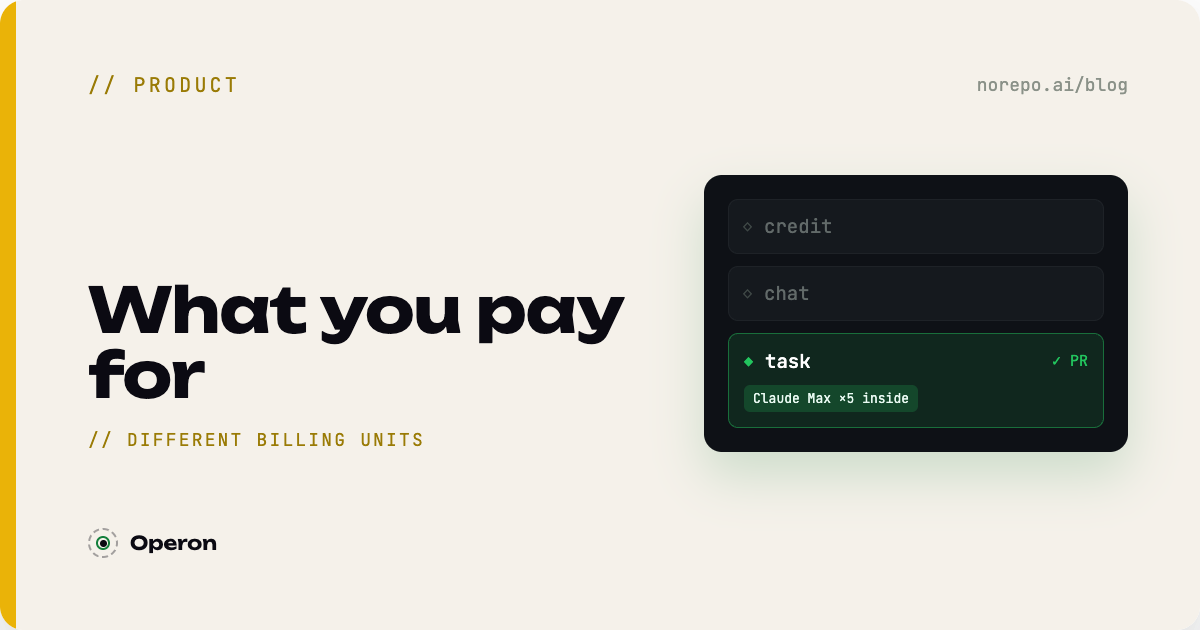
You can't compare the prices of Norepo, Lovable, Base44 and a Claude subscription head-on — not because someone is hiding something, but because they charge for different things. One sells generation credits, another a chat subscription, a third completed tasks. Before looking at the numbers, you have to understand what unit you're actually paying for. Let's break down the three models, gather the current August 2026 plans, and calculate what a product really costs.
Three different billing models
Behind outwardly similar subscriptions sit different units, and that's the whole point.
Builders (Lovable, Base44) charge for credits. A credit is a unit of AI work, usually one message to the agent, spent depending on complexity. Credits have an unpleasant property: their consumption is hard to predict, and they can run out mid-feature.
Claude charges for a chat subscription. It's access to the model: you talk, think, refine. Claude doesn't "deliver" anything as a product — it helps you think.
Norepo charges for completed tasks. "We think not in tokens or lines but in functions described as tasks," says the platform's co-creator, Sasha Shinov. A task is a described function taken to a pull request. You pay for the result, not for consumption.
Hence the first honest conclusion: a Lovable "credit" and a Norepo "task" aren't the same unit, and comparing their counts is meaningless. A credit may end in nothing; a task ends in a result at review.
The plans, as they stand (August 2026)
Below are the current plans. Norepo bills in euros, the others in dollars; the rates are close, but keep the small difference in mind.
| Tool | Free | Mid plan | Top plan |
|---|---|---|---|
| Norepo | 2 tasks/wk | Pro €40 — 15 tasks/wk | Max €150 — 100 tasks/wk + Claude Max ×5; Corporate €750 — 500/wk + ×20 |
| Lovable | 5 credits/day (~30/mo) | Pro $25 — 100 credits/mo | Business $50 — SSO, data opt-out |
| Base44 | 25 messages/mo | Builder $40 — annual | Pro $80 / Elite $160 (up to $200 monthly) |
| Claude | limited free | Pro $20 | Max ×5 $100 / Max ×20 $200 |
Norepo's plans are confirmed on the product's site; Lovable, Base44 and Claude prices are from their public pages as of August 2026 (links at the end).
Why "credits" are anxiety and "tasks" are predictability
The credit model is convenient for the platform but shifts risk onto you. You don't know in advance how many credits a given feature will eat, and when they run out mid-work, you have to top up just to finish what you started. It's no accident that half the builder reviews are about "hidden costs" and the question "what happens when credits run out."
Paying per task removes this anxiety at the model level: the unit is a finished function. You see how many tasks a week the plan gives and know each is taken to a result. Predictability here isn't marketing but a consequence of what you're charged for.
The hidden value: an included Claude
The most underrated thing about Norepo's price is that a Claude subscription is already baked into the higher plans. Max allocates a personal Claude Max ×5, Corporate a Claude Max ×20.
Let's count honestly. Claude Max ×5 bought separately costs $100 a month. The Norepo Max plan costs €150 and includes that very Claude Max ×5 plus the whole platform: agent infrastructure, MCP, preview deploy, review. So net of Claude's cost, the platform itself runs about €60 a month. For Corporate the picture is even starker: a $200 Claude Max ×20 inside.
This is the case where the "expensive" plan, on closer inspection, turns out cheaper than the sum of its parts.
Total cost of ownership: what a product with logic costs
The subscription price isn't the same as the cost of taking a product to prod. Take an honest scenario from the Norepo team: a founder wants to build and run a small product with its own logic (not a static landing) in a month, roughly 60–100 tasks.
On Norepo (Max):
- Operon Max — €150/mo, all included (Claude Max ×5, agent infrastructure, MCP, preview, review).
- Domain — ~€1/mo.
- A small VPS to run it — ~€8/mo.
- Total: ~€160/mo.
On "builder + your own Claude + developer on call":
- Builder (mid plan) — ~$50/mo.
- Your own Claude Pro — $20/mo.
- A developer on call for what the builder can't do — ~20 h × $50 = $1000/mo.
- Domain and hosting — ~$11/mo.
- Total: ~$1080/mo.
The difference is roughly 5–6× in Norepo's favor. But it's important to name the main assumption honestly: almost all of that difference sits in the cost of a live developer. Remove the 20 freelancer hours and the numbers converge; add a more complex product needing more hours and the gap grows. Norepo pays off exactly where you'd otherwise pay a human for code. On a pure landing with no logic that assumption disappears — and there, honestly, a builder is cheaper.
When Norepo is too expensive — and that's fine
There are scenarios where taking Norepo doesn't pay off, and we don't hide them.
First — a single static landing with no backend. A builder is enough here, or even plain HTML on free hosting; an agent platform is overkill.
Second — when the person isn't willing to participate at all. "We welcome laziness in a sense, but not to excess," says Shinov. "If you want to say 'I want an online store' and then just wait for profit, Operon isn't your tool." Norepo removes the routine of execution, but you still do the briefing and acceptance. Whoever expects a business without their involvement will be disappointed — better to know that before paying.
What we don't cut corners on
Two principles that directly affect what you pay for. First — models. Norepo doesn't switch to cheap models to lower the cost of coding; quality stays high even on the free tier. Second — the right to leave. Norepo works on top of your repository, the code is yours from day one. "It's like outstaffing: want to keep going on your own? No problem, it's all yours," Shinov puts it. Hosted builders have a different model: the product lives in their ecosystem, and whether you can take the code out is worth checking before you start, not after.
What to choose for your task on the merits, not just on price, we covered separately: Lovable vs Base44 vs Norepo. And where to begin your first project — in the guide how to start a project in Norepo.
Bottom line
- Prices can't be compared head-on: builders charge for credits, Claude for chat, Norepo for completed tasks.
- Paying per task is more predictable than credits: the unit is a finished function, not consumption that's hard to forecast.
- Norepo Max and Corporate already include Claude Max (×5 and ×20) — separately that's $100 and $200 a month.
- On total cost of ownership Norepo pays off where you'd otherwise need a live developer; on a static landing a builder is cheaper.
Start free: 2 tasks a week, no card — norepo.ai. Plans and what's included — on the business page.
Price sources (August 2026): Norepo plans — norepo.ai; Lovable — lovable.dev/pricing; Base44 — base44.com/pricing; Claude — anthropic.com. Public competitor and Anthropic prices may change after publication — check their sites.